Search Results
Search Results
Title Results
Your search returned 886 Titles

Shot in New Jersey’s declining Livingston Mall, Mall, Interrupted follows the artist in “mall drag” as they perform a litany of self-aggrandizing personal confessions to the camera. Made up in the likeness of former child actor Amanda Bynes, Brush’s character reenacts staged interruptions from the opening moments of Bynes’s The Amanda Show (1999-2002) originally intended as scaffolding for the program’s scripted comedic sketches. The protagonist’s internally-focused monologue is reminiscent of the first-person narrative referenced by the video’s title Girl, Interrupted, which follows a young woman describing her experience of mental illness and institutionalization. Brush exploits the vacancy of post-internet subjectivity alongside the emptiness of the dying public mall, positioning both as rich points of cultural reference. Mall, Interrupted was commissioned as a site-specific video installation for Vonk Centrale in Hasselt, Belgium.


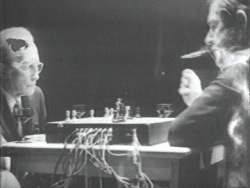
In elegiac work, Kubota explores the relationship between two of the most influential figures in 20th century art and music. The core images are Kubota's own photographs of the famous chess match between Duchamp and Cage in 1968, in which the board, wired for sound, functioned as a musical instrument. Recordings of Cage's compositions accompany the stills and video footage, which Kubota electronically processes to abstraction.
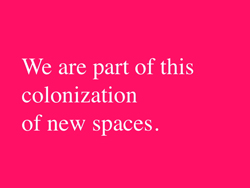
Writes Cokes, "The video animation is based on the closing section of Cokes' and Perchuk's second collaborative presentation, 'Margins and Bubbles,' at 'Our Literal Speed 2' at the University of Chicago in May 2009. Visually, it features text excerpts from an interview between artist Tino Sehgal and critic / art historian David Joselit on contemporary art, the political potentials of the marketplace, and the positive value of 'consumer choice' that took place at OLS1 at ZKM in Karlsruhe."


The artist writes that this work, "a response to Pee Wee's Playhouse, focuses on the girl child, grappling with the fluidity of gender roles as she role-plays with her toys."

From behind a pyramid of TV monitors, perhaps calling to mind the TVs stacked for destruction in Ant Farm’s Media Burn (1975), Jenkins slowly rises, garbed in protective eye goggles and an American flag scarf. He begins to intone a haunting refrain: “You’re just a mass of images you’ve gotten to know, from years and years of TV shows…,” echoing the agitprop of the 1970s guerrilla television movement, which sought to tune people into their manipulation by commercial television. However, Jenkins trains his focus on mass media’s racial oppression.
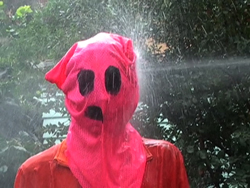
At first glance, Masters of None could be the home video of a family of neon-pink hooded figures, passing the time with charades, television, and Jiffy Pop on the stove. As in All Together Now, Masters has no dialogue or clear narrative arc, and while the domestic activities seem everyday, they...
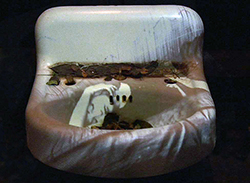
Maya Deren’s Sink explores Deren's concepts of space, time and form through visits and projections filmed in her Los Angeles and New York homes. The project began after Hammer discovered a sink formerly owned by Deren at Anthology Film Archives and embarked on an homage to the "Mother of American Experimental Cinema."